The Execution Gap: Why 2026 Enterprise AI Strategies Fail Without an Underlying Governance and Data Architecture Blueprint
Why so many enterprise AI strategies never reach production, and how pairing strategy with legal constraints, core processes and technical architecture from day one closes the execution gap.
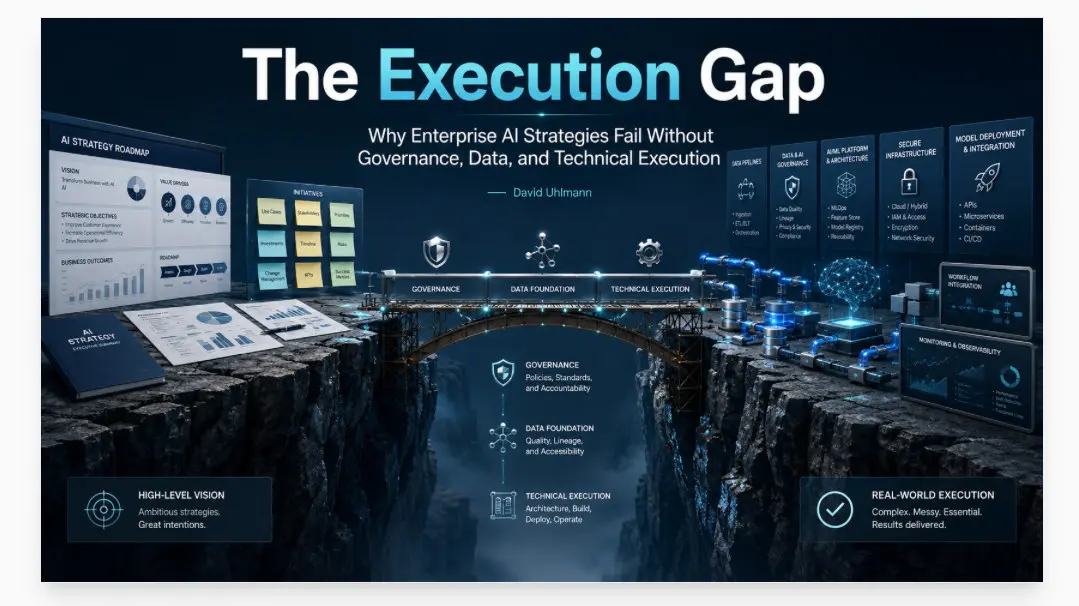
Table of Contents
As of 2026, many organizations are putting millions of euros into AI strategies developed by consulting firms, without much success it seems… More and more research shows that the majority of AI initiatives fail to reach production. While there are many reasons for such a development one I hear more and more from people is a misalignment between strategy and actual technical execution. Companies buy consulting services, get billed two to three million euros, are handed a 200-page PowerPoint deck for the C-level that does not enable them to actually move forward with AI.
There are numerous examples what can go wrong if technical alignment and consulting services are not aligned. Just mentioning one here: Hertz paid a consulting firm a significant amount of money to design and execute a grand global digital transformation roadmap. The strategy decks promised a seamless, extensible global architecture. However, when the implementation phase began, the consulting team seems to have ignored hard integration parameters and wrote code that completely locked Hertz into a single regional ecosystem, was riddled with security vulnerabilities. So the strategy deck and technical realities did not match with led to a double digit million USD dispute.
The actual question asked is: How does the CTO move forward the next morning, once the consulting firm is gone? How can this happen and what to do instead?
Where Consulting Needs to Change and Why
A famous saying goes: Easy answers are always wrong. For the problem described the easy answer would be: (Strategy) consulting firms are just not up to the task of doing AI strategies, do not understand how AI works and just deliver PowerPoints without any real value to customers… This would, of course, be an absolute hilarious oversimplification of a broader problem I see today. Just blaming consulting firms is, and has always been, the simple way out for some people… However, I want to focus a bit on how to improve instead of just repeating simple “anti-consulting” gossip.
I do think that the consulting industry needs a bit of an operational reset. Especially firms that in the past did no technical implementation work and focused only on strategy or management consulting may need to significantly recalibrate for the age of AI. Sending in juniors fresh from university, selling them as ‘AI experts’ for €3k–5k per day to consolidate information from internal interviews, and finally producing a 200-page slide deck for a partner or director to present is no longer enough - or to be precise: This is rather harmful for the customer, not only financially but also in terms of time loss. This decades old consulting process is falling apart as the core model of consulting is shifting. The business model of consulting has always been information asymmetry: The consulting firm has/had knowledge & skills the customer did not have but needed. That is it in the end what is paid for. In the age of AI, this asymmetry is, at least partially, falling apart as without an implementation focus, zero value is created.
Modern consulting needs a way stronger focus on technical skills. This means concretely technical implementation skills. Professionals who develop an AI strategy for a client not only need to understand the regulatory landscape and core business processes, but also the underlying technical realities. This means concretely: Having deeper technical AI knowledge. Alternatively teams need to become more diverse and technical experts need to be involved very early in the project. Having deeper technical knowledge enables consulting firms to create a strategy that can be operationally implemented instead of failing the pilot phase when technical realities hit.
I will just give one very simple example here. Let’s assume a consulting firm is tasked with developing an AI strategy for a large law firm that works with high cybercrime and industry espionage. During the discovery phase (see below), consultants analyze the legislation and core processes, noting that all IT infrastructure of the client runs locally within a private cloud on their own hardware. This has serious implications on the strategy’s concrete implementation later down the road. If a hard requirement dictates that public cloud services are out of the question, the project team must have the architectural background to understand what this means in reality: Getting the respective hardware ready, setting up the backend & orchestration layer for Agents, securely & legally compliant connecting data sources from other systems into the AI backend, fine-tuning models, data governance, information security, model deployment, workflow integration, and continuous production monitoring… If this knowledge is missing, there will be a box in the PowerPoint called “local datacenter” and arrow to another box “AI frontend” and thats it. Without technical depth, no one will foresee that the conccrete engineering reality between those two boxes can completely kill the project later down the line.
In a nutshell: strategy project teams must be multi-disciplinary from day one. Technical execution must be treated as a core pillar, not as an afterthought left for “later” because in enterprise AI, “later” more often than not means “never”.
How to Approach an AI Strategy
When developing an AI strategy, a consulting team can make us of a well-established IT architecture / implementation methodology. However, the framework requires a surgical focus on AI-specific characteristics.
AI strategy & implementation
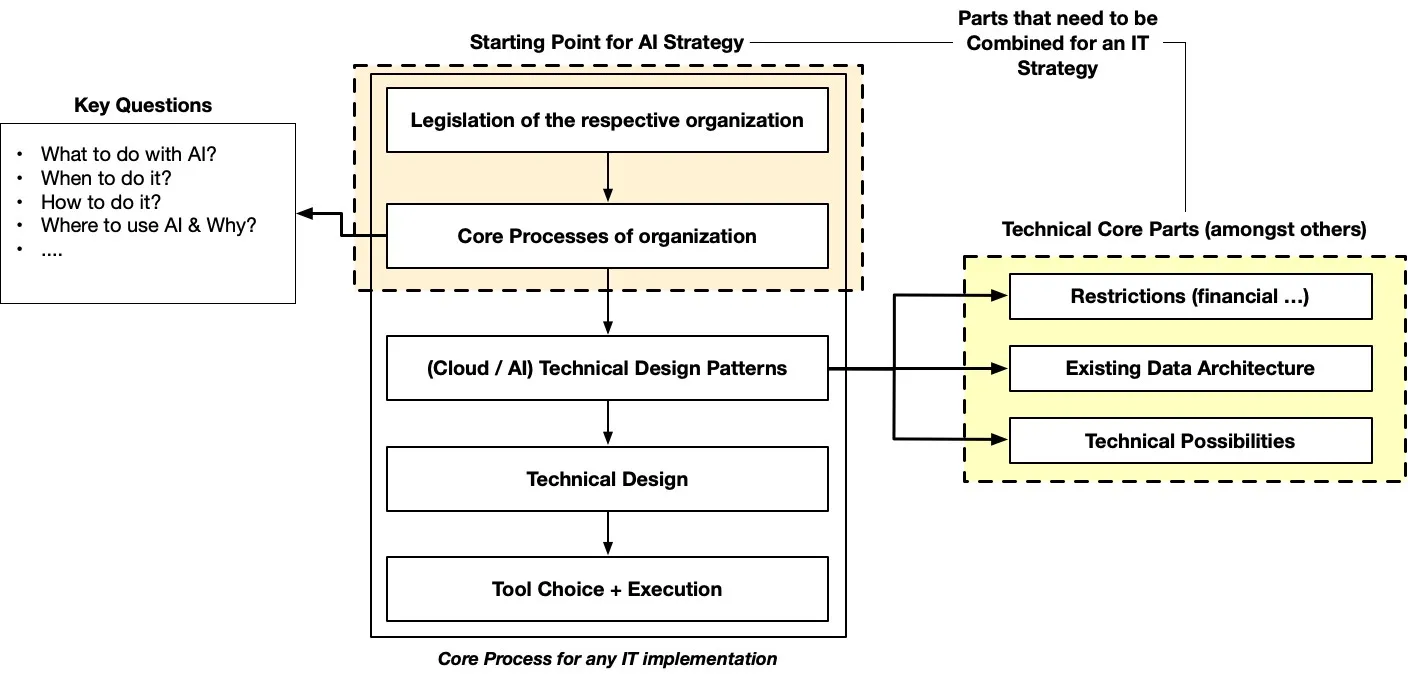
What I would recommend is an integrated approach that lays the focus on AI specific items. When implementing IT projects the process should almost always look like something like this: What laws do I need to follow? What are the core processes within the legislation I operate in. Based on these workflows, specific challenges will surface that can be resolved using proven architectural design patterns, ultimately leading up to a best practices based technical design document (ADD), platform selection, and deployment. For an AI strategy project the project team can cut out a part of this process to understand:
-
What is the legislative framework and legal constraints within which this strategy must operate in? Or in other words. Which laws do we need to follow?
-
What are the core processes of the organization that my strategy needs to support operationally?
This is already a good start in my opinion to answer typical W-questions like Why, Where, when etc. However, I would recommend to not stop here, but grab a part from the technical implementation part of this process (as described above). When combining the strategy with operational IT questions the strategy can be already checked for a concrete technical implementations that scales, is legally compliant & secure and fulfills the wishes of the customer. A good start could be to have a look at ISO42001 for a management system as well. Not to apply it 100% at the start, but to get an idea what is important here.
For technical implementation firms this process feels natural. For implementation firms connecting processes and hard technical & financial requirements into concrete IT implementations has been the bread a butter for many decades. When dealing with AI it is for sure a good idea to work with a firm that has technical expertise to begin with, ideally in the tech stack that an organization operates on. This makes the technical alignment also with the sourounding infrastructure easier. This is not a must, but if an organizations partner for the AI strategy also understands how their Azure is set up, how the Azure Foundry works and how to operationalize those tools to the users it can be a time saver. This is not a must of course and I am biased here of course. Just be aware to not miss out on the part :-)
Wrap up & Summary
While organizations are investing millions into enterprise AI roadmaps, a vast majority of these initiatives do not lead to much or never reaching production. This execution gap exists because traditional corporate consulting frameworks treat AI like static software missing its unique nature. To scale successfully, enterprise leadership should pull technical realities into the initial planning phases as early as possible.
Disclaimer
This post is for informational purposes only & only constitutes the opinion of the author - not the companies the author might be employed and/or connected with in any manner! Also this does not constitute legal advice. For specific guidance related to the topics discussed or other legal matters, please consult a qualified professional / lawyer and/or audit firms tech consultancy advisory for qualified and legally binding answers.
Sources:
- Hertz digital overhaul project: deployflow.co